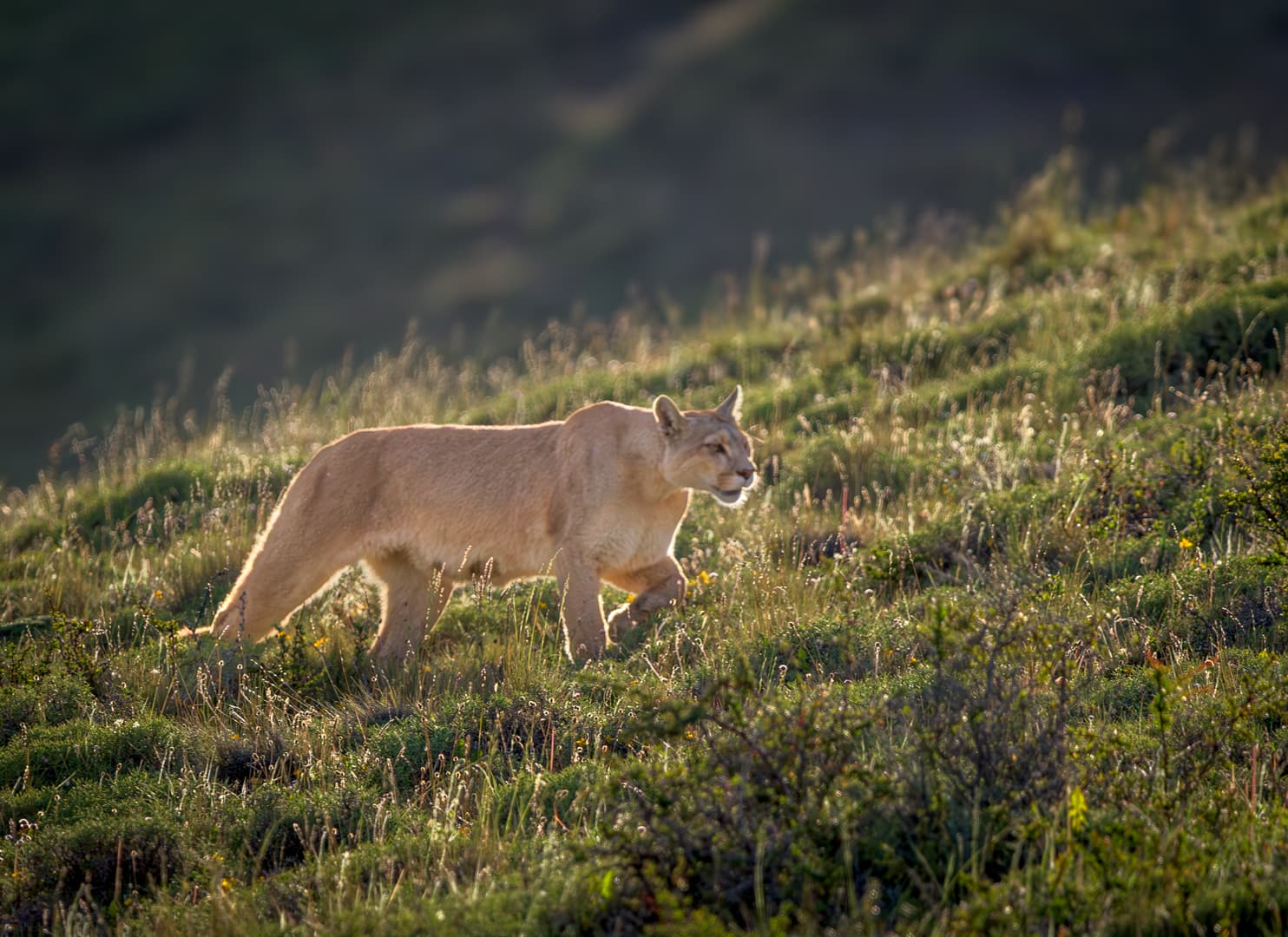
Dania — Queen of the Valley
The evening with the guanacos had filled something in me I didn't know was empty. But I wasn't ready to leave. The puma was still out there somewhere, and I had one more day.
My guide and I drove back into the park the following afternoon. A park ranger stopped to say hello — an old friend of my guide's — and mentioned almost casually that Dania had been spotted hunting in this area earlier that morning. He said her name the way you'd say the name of someone everyone knows. A single female, recently a mother. Three cubs.
The valley felt different after that.
We waited. The landscape that had been full of guanacos the night before was completely deserted — not a single animal in sight. My guide said that was its own kind of signal. When the prey disappears, something is watching.
Then, just over an hour in, my guide grabbed my arm.
"That's Dania."
She appeared at the far end of the valley — a tawny shape moving through the grass with a purpose that made everything else go still. She saw us immediately and didn't flinch. She simply continued, occasionally glancing our way to confirm we were no threat. She crossed the road we were standing on twice, her massive paws silent on the gravel. At one point she passed within seventy-five feet of where I stood.
Then she made a sound — not a roar, something quieter and stranger. My guide nodded.
And then the bushes moved.
Three cubs came tumbling out into the open, falling over each other in their hurry to reach her. They were small and impossibly fluffy and completely unafraid. Dania pulled the morning's kill from the undergrowth and within moments the cubs were at dinner — jostling, climbing over each other, ears back, tails twitching.
We watched them for over two hours.
The cubs wrestled between bites, chased each other through the grass, batted at their mother's tail. Dania sat apart occasionally, watching the hillsides with that steady, ancient gaze — alert for the males who sometimes appeared to steal a meal, alert for anything that threatened what was hers.
As sunset came the wind picked up and the temperature dropped sharply. I barely noticed.
A photographer who stopped to watch told me quietly he had been trying to photograph pumas in Patagonia for three weeks without a single sighting. He had tears in his eyes. That moment made me understand something — how hard this landscape is, how thin the margin between survival and disappearing. Pumas have lived in these winds for thousands of years. Dania was still here, feeding her cubs, carrying her bloodline forward.
We drove back in the dark. I flew home the next morning. But something from that valley came with me — a feeling somewhere between gratitude and awe and the particular peace that comes from witnessing something wild and true.