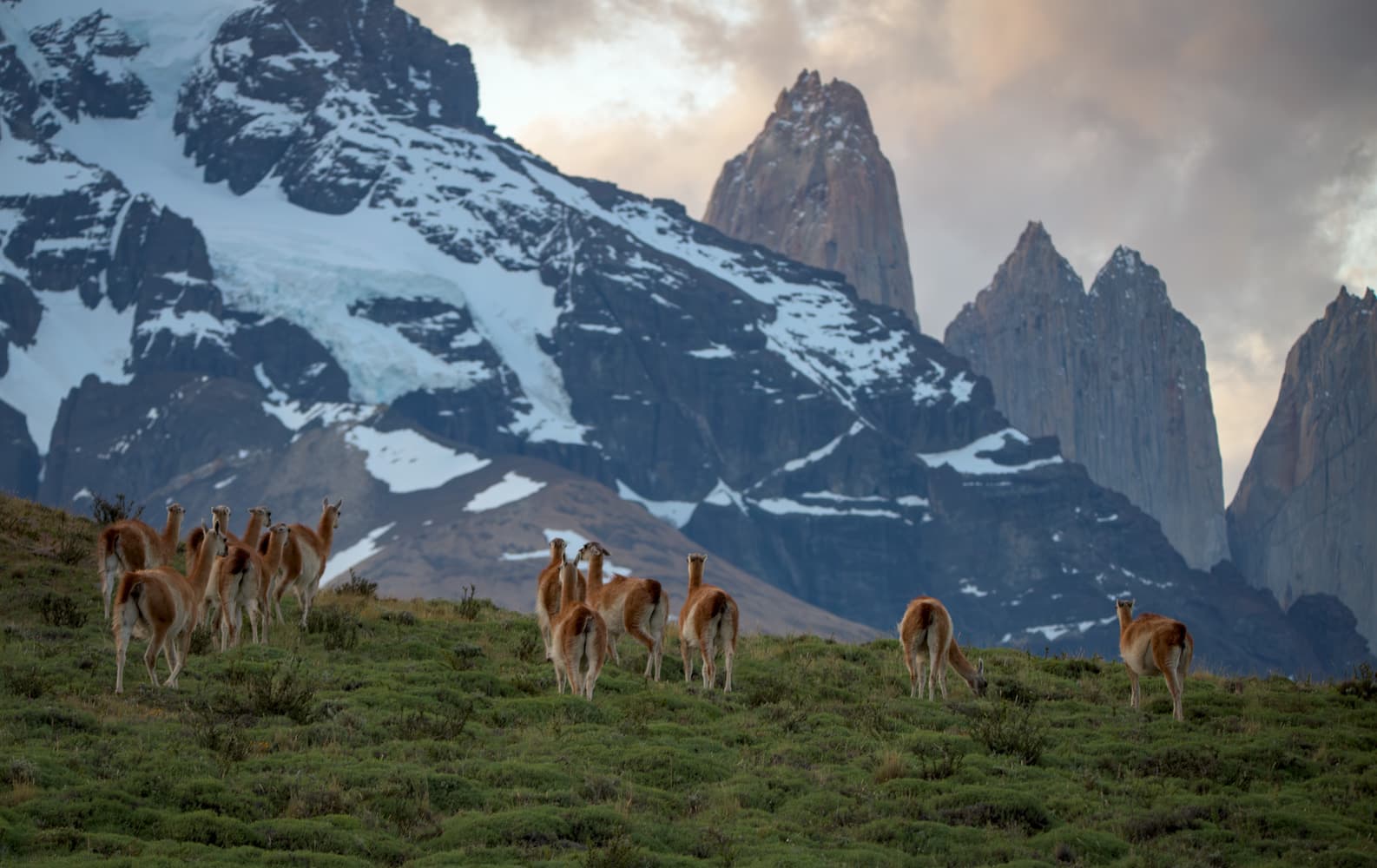
Guanacos of Torres del Paine
I had just finished the O-Trek — eight days of hut-to-hut hiking through one of the most demanding circuits in Patagonia. My legs were tired, my pack lighter, and Thanksgiving had come and gone somewhere on the trail. Back in Puerto Natales, I spent a day eating well and moving slowly through the cafes and bakeries of that quiet little town at the edge of the world. It felt earned.
But I wasn't done with Torres del Paine.
I had arranged a two-day puma tracking trip with a local guide — a wildlife photographer who had spent years learning to read this landscape the way most people read a map. That afternoon he drove me back into the park, through sections I hadn't seen on the O-Trek, and by four o'clock we were parked at the edge of a valley where he said the cats sometimes hunt.
We waited. An hour passed. Nothing.
Then the guanacos began to move.
Not grazing, not resting — moving. Groups breaking apart and reforming, heads turning, feet shifting. My guide watched them quietly and said: that's what it looks like when a puma is close. The prey animals feel it before we do. Their nervousness is the announcement.
The puma never showed itself that evening. But what unfolded in that valley over the next hour was something I hadn't expected — a display of guanaco life so rich and unhurried that I forgot I had come for something else entirely. Mothers with newborn chulengos barely steady on their legs. A solitary adult calling out across the hillside, mouth open wide, the sound carrying in the cold air. A herd of fifteen moving in loose formation along a ridge, the towers of Torres del Paine rising behind them in the last light.
I put down the idea of the puma and just watched.
There is something deeply calming about spending an evening with animals that have no interest in you — that move through a landscape entirely on their own terms, alert to things you cannot see, unhurried by anything you might do. The guanacos of Torres del Paine have lived alongside pumas for thousands of years. They know exactly how much danger feels like. Watching them that evening, I thought: so do I. And maybe that's why being out here, surrounded by all of this, feels less like escape and more like coming home to something true.
The puma would show up the next day. That's a different story.
That evening belonged to the guanacos.