Leaving the Camera Behind
The night before I flew out, the pack was by the door and I was still nervous. I'd been training for months and there was nothing useful left to do, so I told myself what I always tell myself: the training and the prep are done. Nothing left now but to watch it unfold.
I meant it as reassurance. I didn't know I was making myself a promise.
Inside the pack, as always, was the camera — a Nikon D810 and the lenses I choose by weight rather than by what they can do. About four kilograms. I've carried it through Patagonia and around Mont Blanc without once questioning it. I don't hike in order to photograph. I photograph because I'm out there anyway.
I had one free day in Cortina before the trail and spent it at Cinque Torri, where I walked into something I hadn't expected: locals in full period uniform moving through the restored First World War trenches as though they had somewhere to be. I photographed three of them talking among themselves, rifles laid along the wall, Tofana di Rozes filling the gap behind their heads.
It's the best photograph I made on the entire trip. The camera earned its weight that morning. It earned it completely.
It never earned it again.
The trail began at Lago Braies, which is as beautiful as everyone says. I took my photographs from the shore, then turned and started climbing.
It was already hot. The climb out of Braies is relentless and almost entirely exposed, and within an hour the heat had stopped being weather and become a presence, pressing on my shoulders alongside the pack. Somewhere on that slope, for the first time in years of carrying a camera into mountains, I thought it clearly: I could leave this bag here.
I didn't act on it, of course. The body sorts itself out on long walks. Everyone knows that.
Mine didn't. Two days later, after a rough climb to Rifugio Fanes and a night in which my body made its position clear, I stood outside the hut looking at a long exposed stretch up to Lagazuoi and did the arithmetic honestly, probably for the first time. The answer was no. Not with this body.
So I didn't go. I took four separate buses around the mountains I'd come to walk over and arrived at Col Gallina feeling like a man who had quit. Then I did the thing I should have done on the climb out of Braies. I called Mont Trekking and asked whether they could carry my camera gear ahead to Belluno. They said yes, easily, as though people asked them this all the time.
What I felt when I hung up wasn't triumph. It was relief — the kind you only feel when you've been carrying something heavier than you were willing to admit.
I handed the bag to a driver in the Passo Falzarego car park the next morning. Ninety seconds, no ceremony. Then I rode the cable car up to Lagazuoi. I didn't earn that summit, I bought a ticket for it, and two days earlier that would have bothered me.
At the top I walked out onto the terrace and got emotional. Properly, embarrassingly emotional, among people eating their lunch.
It caught me off guard until I understood it. I'd been in these mountains four days and hadn't actually looked at them. I'd been managing — the heat, the climbs, my stomach, the weight, the arithmetic of how far to the next hut — and somewhere in that the Dolomites had become terrain to get across. Here they were again, and I could see them.
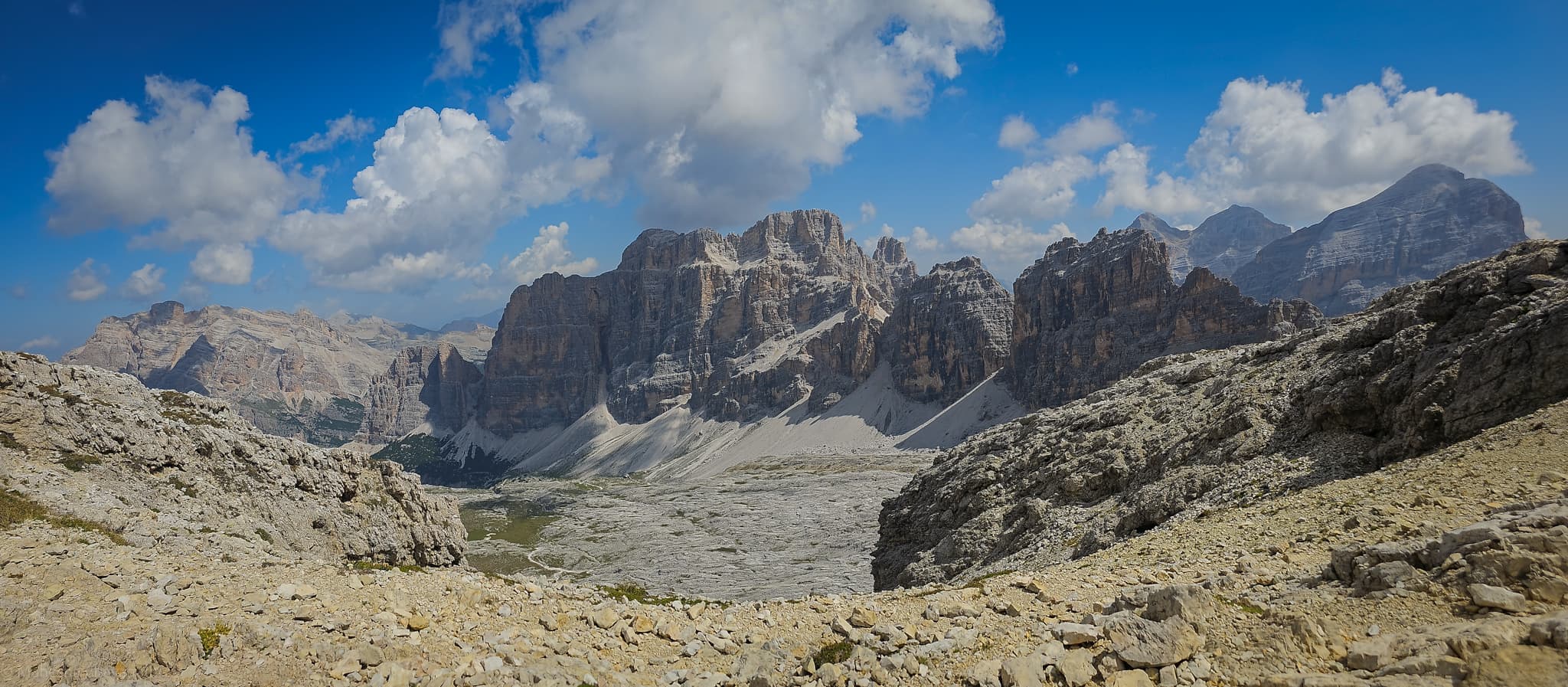
I spent three hours up there doing very little, and photographed all of it with a phone. What the phone gave me wasn't image quality. It was permission. No bag to unshoulder, no lens to choose, no decision about whether a view justified the effort. Half of what I made that day were panoramas — something I'd almost never bothered with, because with the Nikon a panorama is a project and with a phone it's a gesture.
I didn't miss the D810 once. I've thought about that a great deal since, and I don't think it's a story about cameras.
The next day I climbed to Rifugio Averau and then on up to Nuvolau, and I did not want to come down. Long, hot, brutal by any measure, and one of the finest days of walking I have ever had. Somewhere up there I noticed I was loving the hiking again — something I hadn't been able to say since the trailhead.
Four kilograms. It wasn't the only thing that had changed: I'd rested, I'd skipped a hard day, my stomach had settled. But it was the one I could feel in every step. A humbling thing to discover at fifty-one — that the obstacle had been sitting in my own pack the entire time, and that I'd carried it four days past the moment I first thought about putting it down.
Two days later, the climb from Lago Coldai up to Rifugio Tissi undid me. Not the hardest section of the route by any measure, but the last thirty minutes took everything I had and a little more.
I have four photographs from that day. I have none at all from the days after it.
I took a rest day at Tissi and did nothing at all, which was exactly the plan. I set off the next morning feeling genuinely rested. It didn't hold.
Two days on, I reached Rifugio Carestiato exhausted and with no appetite. But two people made that evening.
The waitress mentioned that she'd spent time in Mysore, doing yoga training, and then asked politely whether I happened to know it.
I said: I was born there.
And at dinner I sat across from a German man who was walking from Munich to Venice. Not the Alta Via 1 — Munich, to Venice, on foot. He described it the way you'd describe a commute. I'd spent nine days feeling like I was attempting something ambitious, and across the table was a man for whom my entire trip was a segment. For the first time all week, I felt like the normal one.
Partway through the meal he noticed that I wasn't eating and asked why. I explained that I was dehydrated and had lost my appetite. He raised an eyebrow, said "That's no good!", and went back to chugging his beer.
I went to bed laughing, woke in the night unwell again, and by morning I knew. Over breakfast I messaged Mont Trekking and asked them to collect me from Passo Duran. Then I walked down, slowly, on a body that had nothing left to prove to me.
I did not finish the Alta Via 1. I want that stated plainly, because it's true and because the rest of this doesn't work if I dress it up. There were two days of trail left and I didn't walk them.
I have never once regretted it.
The promise I'd made myself the night before I flew out turned out to be the only useful instruction I gave myself all summer.
Twice — once outside Rifugio Fanes, once at Carestiato — the mountains asked me a straightforward question and I gave the same answer both times. The first answer saved the trip. It got the weight off my back and gave me Lagazuoi and Nuvolau and the finest day of walking I've had in years. The second ended it. I've come to think they were the same decision, made twice, by someone finally willing to believe his own body the first time it spoke rather than the fourth.
That is what I carried home instead. Not a completed route, and not the photographs I'd planned to make with the camera I left in a van at Passo Falzarego. Just the increasingly clear sense that at fifty-one the useful skill is no longer pushing through. It's noticing, early and without shame, when something needs to be put down.
The camera is back on the shelf. It'll come on the next trip, wherever that turns out to be.
I'll just be quicker to admit when it's time to hand it over.
Gallery
Want to see more from the trail? You can browse the full photo collection here.